

An entrepreneur’s true value is often found nearest their true interests.
And I love facilitating “Novel Token Sessions” with my clients.
Essentially, it’s our opportunity to create unique “tokens,” the base units of language, to borrow a term from the AI industry.
They’re 30-minute conversations with my clients that we try to have most weeks.
What happens? I ask them questions they’ve never heard before, so they can give me answers they’ve never uttered before.
All so that we can create marketing content that’s never been written before.
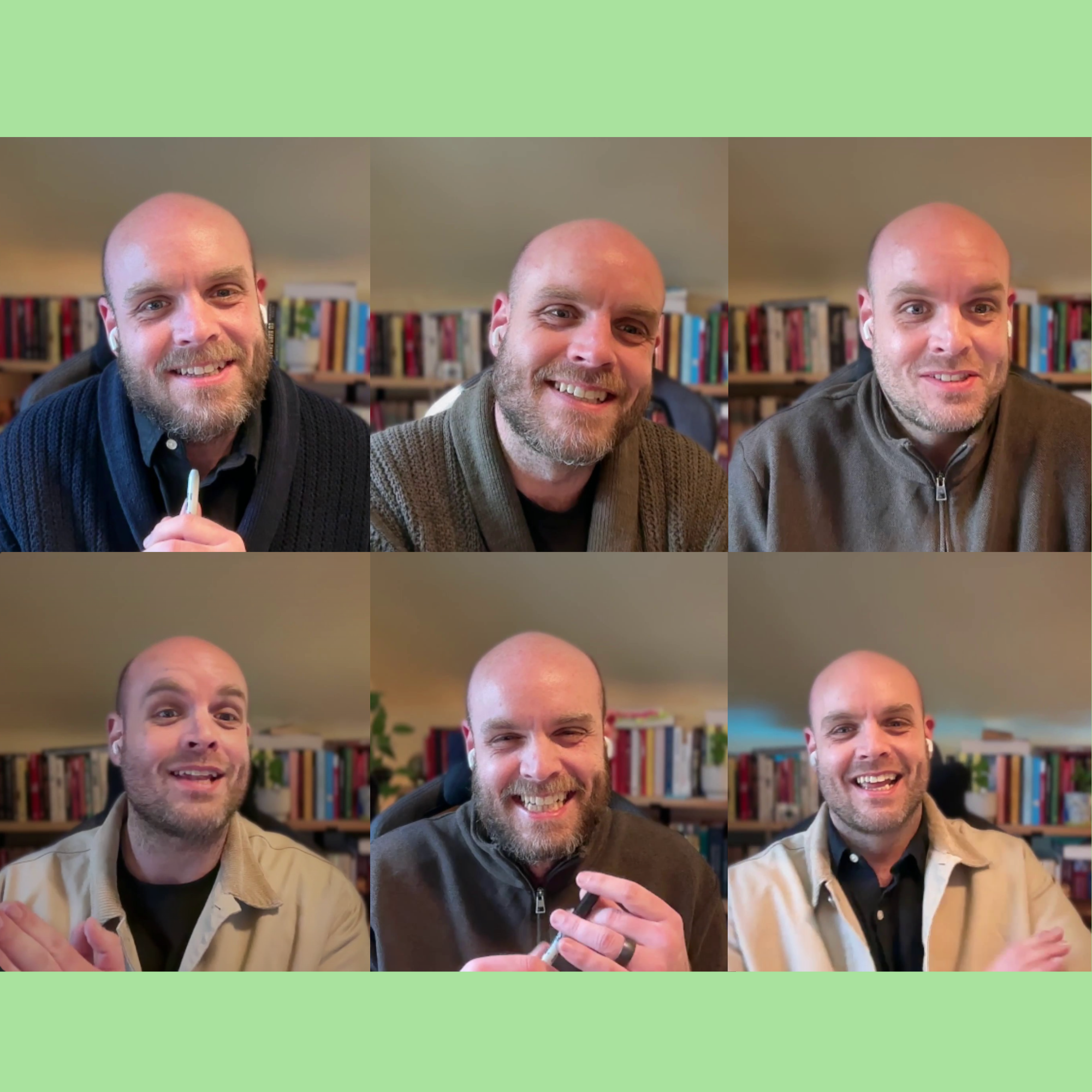
When I tell other marketers about these sessions, the first question is almost always, “How do you get your clients on a call that often?”
And it’s actually sort of simple? I just tell them:
“I can write great content on my own. I’ve published almost 1,000 of my own newsletters over the past few years. But we need to create content that’s yours. Your insights and your experiences. Because it’s your value, not mine, that we’re demonstrating."
No one’s ever argued with that, or not seen the value in it.
I go into them prepared, but I rarely ask my clients to prepare. I usually don’t even send them my questions beforehand. I want their honest, actual reactions, not pre-gurgitated responses.
I always have five or six questions I’m ready to ask, so the client is never waiting for me to think of something. For them, it needs to feel like a packed, dense conversation so they experience its value in the moment.
But I pull on interesting threads, chase down leads, and loop back to previous points to make sure we’re fully exploring the meaning space in their mind that makes them unique and useful to their clients.
Because it’s got to be useful.
Marketing is demonstrating value at a distance, and the best way to demonstrate is to deliver.
You can’t do that by relying on public information, like a Google search or a ChatGPT research project. Anyone could do that, which means that content has already been produced by someone before.
This is about getting to something truly unique, and truly rooted in the real-life experiences and embodied intelligence of my client.
Marketers often interview their clients and fall back on generic questions: “Why do your customers like your product?” “How do you help your clients succeed?”
Those generic questions invite generic answers that sound like everyone, or anyone, else might. That’s just not good enough for making meaningful content.
So I like to think about it this way:
“Tell me about yourself” is a famously bad question, right? Nobody knows what to say. But if I say, “tell me what you did this week,” more comes to mind. If I say, “what did you do this morning?” you know exactly what to say.
The more specific you can be in the question, the more specific the answer. Details can then be abstracted as necessary. But you can’t go the other way around.
For example, last year I asked a client to cast himself forward into the next year, and tell me, “What do you know in 2026 that you didn’t know in 2024?”
Why the leap forward? Well, casting ourselves into the future, we have more “scope for the imagination,” as L.M. Montgomery’s Anne Shirley might say. Next year is infinitely long and filled to the brim with promise, while the current year is always over before it starts.
But when I asked that question, his first answer was winding, even scattered. At first glance or listen, it didn’t give me much to work with.
He pointed out a few places where he’d learned more about his clients’ businesses, and how some of the things they’re doing to transform their work could transform his, too.
But he ended with, “And then we’ll apply that knowledge to communicate, to have conversations with either new prospects or existing clients about building value in their companies, too. So it’s kind of neat.”
Kind of neat.
I think a lot of marketers or interviewers would move on from there, on to the next question on their list.
But I try to pay attention to body language, even over Zoom. To phrases or expressions that seem to suggest there’s more to be said if there’s more to be asked.
In this case, it was the “kind of neat” part that triggered my curiosity.
So I asked, “How is that going to affect next year? How is that going to affect the type of advice you’re giving your clients?”
His answer to the follow-up became part of the foundation of our entire approach to their content:
He said, “I think it’s going to be transformational in terms of the relationships that we have now, because almost up until this year, all the conversation we’ve had, like a lot of other advisors, has been around really just a few areas ... but [next year] the conversations are totally different. We’re gonna provide our typical services, and we’re gonna do a really good job, but that’s gonna be a byproduct of what we do with the business advice.”
His first answer suggested they’re going to expand the scope of their advice. His second answer, to the targeted follow-up, told me how.
I'm always driving toward the tangible. The specific.
At the bottom, all my questions are always heading toward, “But what changed in the world because that’s true?”
I like to say my entire secret is being the most curious person in the world. And the way to get better at anything, but especially interviews, is to practice being more curious.
To have, as advertising legend Mary Wells Lawrence put it, “The nosiness of a detective.”
Then, when it’s time to create marketing content, I can mine these transcripts, these past expressions of value, and turn them into content that’s in my clients’ own words and phrases.
Based on the marketing strategy we’ve developed with them, I’ll choose topics, create outlines, and then assemble their statements into cohesive and coherent posts, newsletters, ads, or articles.
This process can be done entirely manually, but sometimes machines help, too.
I have thousands and thousands of words from my clients to parse through whenever I go to develop their content, but my squishy human brain has a limited “context window,” in the parlance of the day.
Modern text analysis tools can help me track down verbatim quotes based on an outline, if a client has approved my use of those tools.
Then, I literally keep the outline, filled in with client verbatims, on one screen, open my text editor on the other, and hand-type the piece of content.
Any gaps get filled in by own brain, hands, and effort, avoiding AI-isms and the slippery slope of slop.
You know those phrases, like, “It’s not just a transformation. It’s a win-win.”
Or, “And honestly, the part that struck me was...”
Or, “The real kicker? It helps them...”
Or, “This one hits different.”
All those little AI-isms that sneak into content because the writer had it fill in the gaps itself, which means it mined its training data for smooth and empty phrases that sound meaningful but aren’t.
I get it! It would be so easy to just have the AI write it all itself. So easy, so pointless.
Because it would not only actively remove value by supplanting it with its own phrases, but it would diminish the appearance of value by looking like slop.
Turns out, the messiness, the imperfectness, the disfluency of human speech and writing is the point of writing at all.
Those disfluencies are the burrs by which ideas stick in the mind.
When my client said, “So it’s kind of neat,” I felt a burr burrow, if only slightly. I knew we were stumbling upon something worthwhile and unique.
That’s the path to follow for unique, insightful, and valuable content. And I invite you to borrow this process for yourself.
Because here’s what I love about this process: If you duplicated it exactly with yourself or with your clients, our content would never overlap.
This process is about uniqueness, about mining for insights buried deep within the mind of an expert that must be withdrawn with effort, energy, and time.
It’s human in, and human out, the whole way.
If you start running your own sessions, I haven’t lost a thing. But we’ve both benefited.
Because by making your content more unique, you’ve made mine and my clients’ moreso, too.
Here’s a tip, though: Be prepared, but don’t fall back on a checklist or a questionnaire. People can feel a proverbial clipboard and they don’t like being treated like they’re data to be extracted.
Instead, fall back to depth, to deeper inquiry, when you run out of prepared questions.
Practice saying, “Can you give me an example?”
I invite you to try this out the next time you need to create content on behalf of a client, a colleague, or even yourself.
Remember: prompting your own creativity works almost as well.
All I ask is that you tell me how it goes.
Kelford Inc. are content marketers for expert advisors. If you’re struggling with what to say and where to say it to attract your ideal clients, we’ll show you the way.